
Human Behaviour
Understand unconscious influences
New Book Coming in 2027
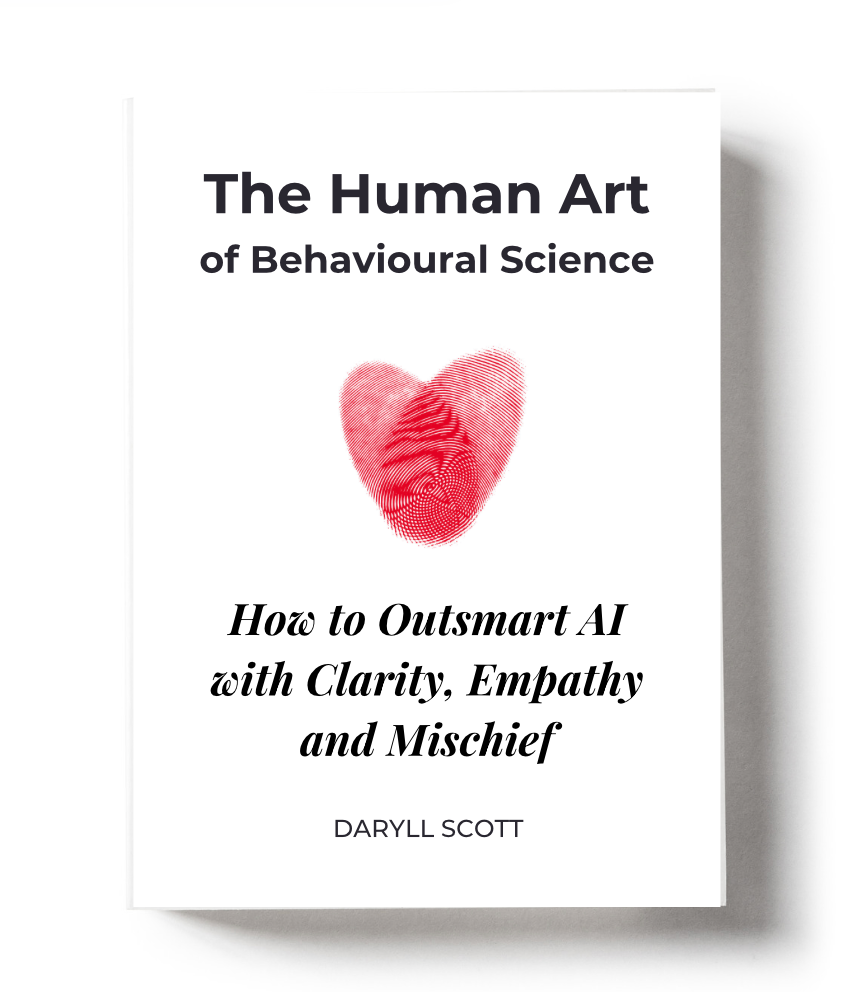
The Human Art of Behavioural Science
How to Outsmart AI with Clarity, Empathy and Mischief
As we focus on the offer, the message, the script, we ignore hundreds of powerful unconscious influences.
People aren't moved by words; they respond to the imagination those words spark and the feelings they evoke. Most of the time, people make decisions unconsciously, and then rationalise them afterwards.
I help people understand unconscious influences and use them to master their mind, create compelling communication and design better experiences.
With 25 years’ experience training people in communication, I bring practical behavioural science to the moments that matter: Winning business, engaging an audience and turning a difficult customer into a future advocate.
Articulate value and negotiate with confidence in the age of AI.
Is your AI strategy filling your wallet or picking your pocket?
Tasks that once took hours now take minutes, and clients always see faster delivery as an opportunity to pay less. If you explain your value through time and deliverables, you get dragged into defending how long something takes.
This behavioural science training develops the communication, influence and negotiation skills to make value clear and protect it under pressure.
Move the conversation from what you do to the difference you make.
Participants learn how to build trust, understand what shapes perceived value, tell credible stories with influence, respond to objections and negotiate with influence.
Your team will be able to:
- Connect with priorities and focus on relevant challenges, outcomes and differentiation.
- Create compelling narratives, shifting from reporting case studies to emphasising the salient points that really matter.
- Negotiate better outcomes, handling price pressure and overcoming objections with assurance and value.
Reframing Value in the Age of Automation
My approach brings behavioural science into everyday commercial conversations to demonstrate how attention, trust, framing and anchoring shape perceptions of value.
We connect those principles with practical interpersonal communication skills:
- Connection: Capture attention, build interpersonal comfort and deepen trust.
- Perceived Value: Understand the heuristics that shape value perception
- Shifting Focus: From outputs to outcomes, and from outcomes to impact
- Ethical Influence: Utilise priming, framing, anchoring, biases and nudges.
- Structuring Narrative: Provide information that reinforces value and differentiation.
- Storytelling: Use narrative to make messages credible, memorable and convincing.
- Negotiating: Maintain influence, overcome objections and encourage action.
Tell the influential stories that make your messages matter
Just Imagine…
- You are walking onto the stage or beginning the online presentation
- You feel physically relaxed, your mind is clear, and you are fully present
- Your content is memorable and structured for all psychological styles
- You are confident that your opening story will captivate and connect
This may seem like an extreme step-change, but it is entirely achievable.
I help professionals make public speaking, business presentations and corporate storytelling more engaging and influential. Drawing on 25 years of communication training, my approach develops three essential elements of influential presentations.

“Daryll helped me unlock the joy of public speaking, which influenced the visibility and success of my business and the long-term trajectory of my career.”
Rob Belgrave
Global COO

“When I met Daryll, I was already an experienced speaker. Through our collaborations, I discovered ways to create more playful and emotionally engaging audience experiences.”
Leon Taylor
Olympic Medalist

“Daryll Scott is the master of storytelling. He brings your message to life in a way that resonates with your audience, is influential, and they won’t forget it in a hurry.”
Becky Simms
CEO
1. Building a presentation state
You can know your subject inside out and still feel your heart race, your thoughts scatter or your body tense. We work with self-talk, expectations and physical responses, using practical mental and physiological techniques to help you manage presentation nerves and recover your composure.
Unconscious reactions require unconscious coaching. You’ll learn to:
- Recognise and interrupt unhelpful self-talk.
- Approach presenting with helpful expectations.
- Develop a more relaxed, playful and responsive presence.
2. Designing a coherent structure
We tend to present things the way we understand them, but our audience may think differently and have different questions.
Using a psychological model, you will learn to:
- Turn complex thinking into a clear, memorable message.
- Build presentations that address different audience personalities.
- Create a focused, persuasive 60-second elevator pitch.